
Cloud & FinOps
The infamous ‘Cloud Shock’ and the Budget Hole
For years, the promise of cloud computing was lower costs and endless flexibility. However, the reality for many enterprises turned out to be a painful ‘Cloud Shock’. Because developers in the cloud can launch complex infrastructure and heavy databases with a single click of a button (without first going through the slow approval process of the purchasing department), organizations are losing their grip on their spending. Millions of euros evaporate annually on ‘zombie servers’ that run but do nothing, oversized databases, and forgotten test environments. The solution to this financial leak is FinOps (Cloud Financial Operations).
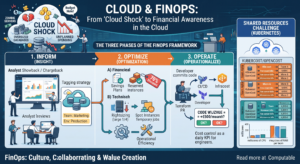
FinOps is not a tool, but an operational framework and a cultural shift that brings finance, operations (IT), and engineering together to maximize the business value (ROI) of the cloud. In FinOps, it is not simply about saving money, but about understanding *why* the money is spent.
The Three Phases of the FinOps Framework
Successful FinOps implementations follow an iterative lifecycle consisting of three core phases:
- Inform (Insight): The absolute basics. It is impossible to manage costs that you cannot allocate. Companies must implement a rock-solid ‘Tagging’ strategy. Every cloud resource must have labels (e.g.
Team: Marketing,Environment: ProductionVia dashboards (such as AWS Cost Explorer or specialized tools like Cloudability), each development team gains real-time insight into their own cloud spending (Showback) or costs are charged internally (Chargeback). - Optimize: Once insight is gained, optimization begins. This takes place on two axes. Firstly, financially: purchasing ‘Reserved Instances’ or ‘Savings Plans’, whereby you commit to cloud usage for 1 or 3 years in exchange for discounts up to 70%. Secondly, technically: implementing ‘Rightsizing’ (downgrading a server from 32GB RAM to 16GB if it turns out to be using only 10%) or deploying inexpensive ‘Spot Instances’ for temporary workloads.
- Operate (Make operational): Cost control is becoming a daily KPI for engineers, just like application speed. CI/CD pipelines are being enriched with tools such as Infracost, allowing the developer to see immediately with every code change (Terraform pull request): “This change is going to cost us an extra €500 per month, do you agree?”
The Shared Resources Challenge (Kubernetes)
One of the biggest headaches in FinOps is allocating costs within Kubernetes clusters. Because Kubernetes groups multiple microservices from different teams onto a handful of physical (shared) servers, the AWS bill can no longer tell which team incurred the costs (after all, AWS only sees a large server bill). Tools like Kubecost and OpenCost solve this by diving deep into the Kubernetes API. They calculate exactly how many millicores of CPU and megabytes of RAM each individual microservice has consumed during the month, and translate this back into euros per team.
Culture Over Control
FinOps is successful if it embraces a ‘blame-free’ culture. The goal is not to reprimand developers, but to give them ownership of their own cost budgets (Unit Economics). If a team discovers that rendering a single video generates €0.05 in cloud costs, they can discuss with the business whether this is profitable within the current subscription structure. Read more about cloud economics and strategy at Computable.
Next: Serverless Containers: The Battle Between AWS Fargate and Google Cloud Run
