
Cloud & AI
The Evolution of Cloud Infrastructure through Artificial Intelligence
Cloud computing and artificial intelligence (AI) are often mentioned in the same breath, and that is no coincidence. While the cloud provides infinite computing power and storage capacity, AI offers the intelligence to process these enormous amounts of data meaningfully. Without the scalability of cloud environments such as Amazon Web Services (AWS), Microsoft Azure, and Google Cloud Platform (GCP), advanced AI models as we know them today simply could not exist. The synergy between these two technologies forms the backbone of modern IT infrastructure and fundamentally changes how businesses operate.
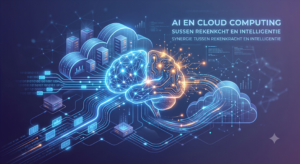
For IT professionals, this means a shift from traditional server management to orchestrating intelligent, distributed systems that proactively anticipate business objectives.
AI-driven Cloud Optimization (AIOps)
One of the biggest challenges in cloud computing is managing costs and performance. Companies are often faced with ‘cloud shock’: unexpectedly high bills due to inefficient use of resources. Here, AI offers a solution through AIOps (Artificial Intelligence for IT Operations). AI algorithms continuously analyze resource consumption, network traffic, and application performance within the cloud.
Instead of a cloud engineer having to manually scale servers up and down, the AI predicts when traffic peaks will occur based on historical data and real-time trends. The system automatically scales up the necessary containers (via Kubernetes) and, more importantly, scales them down again as soon as the peak has passed. This leads to an optimal balance between performance and cost, and minimizes downtime.
Machine Learning as a Service (MLaaS)
The major cloud providers have drastically lowered the barrier to entry for getting started with AI by offering Machine Learning as a Service (MLaaS). Services such as AWS SageMaker, Azure Machine Learning, and Google Vertex AI enable developers to train and deploy complex models without needing in-depth knowledge of data science themselves.
These platforms offer ready-made APIs for image recognition, speech-to-text, sentiment analysis, and translations. As a result, software engineers can integrate these functionalities into their web or mobile applications within a few hours. This democratizes access to AI and enables even the smallest start-ups to compete with tech giants by offering intelligent features.
Security in the AI-powered Cloud
With the integration of AI into the cloud, the security landscape is also changing. Traditional firewalls and rule-based systems are no longer sufficient to fend off sophisticated cyberattacks. Cloud providers are now deploying AI to detect anomalous behavior in network traffic (anomaly detection). If a user suddenly logs in from an unusual location and attempts to export data en masse, the AI system intervenes within milliseconds by isolating the account and enforcing multifactor authentication.
In addition, AI helps continuously scan cloud configurations to identify vulnerabilities, such as open S3 buckets or misconfigured IAM permissions, before attackers can exploit them. This principle of Continuous Cloud Security Posture Management (CSPM) has now become a requirement for every serious enterprise environment.
Strategic Implementation and Future Vision
Integrating AI into your cloud strategy is no longer an option, but a necessity to remain competitive. However, the transition requires careful planning. Start with a thorough data audit: after all, AI models are only as good as the data they are fed. Ensure a centralized data lake architecture where structured and unstructured data can be securely accessed for analytical purposes.
In addition, this requires a cultural shift within the IT department. Cloud engineers must retrain in the fundamentals of machine learning pipelines (MLOps) to bridge the gap between development, operations, and data science. By investing in knowledge and embracing cloud-native AI services, you create an agile, future-proof IT infrastructure that stimulates innovation rather than hinders it.
For a deeper insight into current cloud strategies and the role of AI, we refer to this. analysis about Cloud and AI on Computable.
Data Engineering: The Indispensable Foundation for Successful AI
